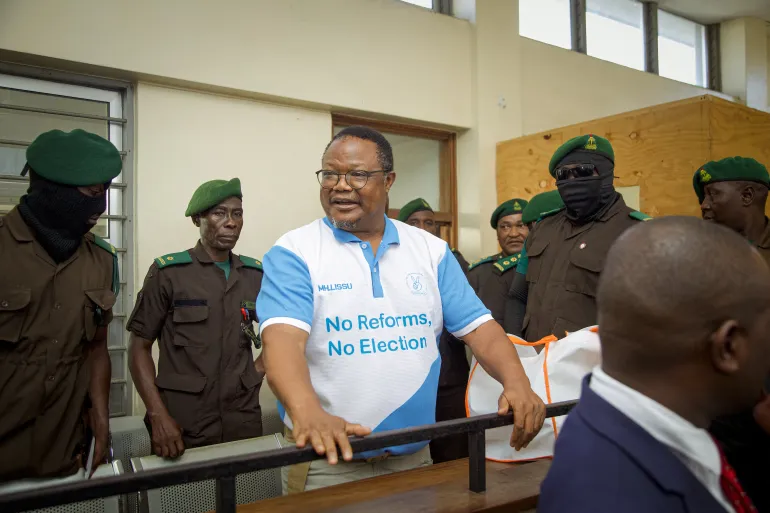
The photograph says everything.
Tundu Lissu stands at the dock of a Tanzanian courtroom, flanked by armed court officers in dark green berets. Some wear balaclavas concealing their faces. He is the one man in the room not dressed for combat — wearing instead a white and blue polo shirt bearing the words: “No Reforms, No Election.” The slogan of his campaign. Worn into his own trial.
The image, captured by AFP photographer and distributed internationally, has become an emblem of Tanzania’s democratic crisis. In a single frame, it captures the asymmetry at the heart of the persecution of Tundu Lissu: a man committed to peaceful, constitutional change, surrounded by the armed instruments of a state determined to prevent it.
The Charges He Faces
Lissu has faced sedition charges arising from statements made during the course of political campaigning and public advocacy — statements that, in any functioning democracy, would be considered the ordinary exercise of the right to free speech and political participation. The charges have been pending for years. They have been delayed, rescheduled, and repeatedly used as instruments of disruption: his court dates have been scheduled to coincide with party events, electoral registration deadlines, and political rallies.
This is the pattern Amsterdam & Partners has documented before international bodies including the UN Working Group on Arbitrary Detention, the Inter-Parliamentary Union, and the Commonwealth Secretariat. In each forum, the conclusion is the same: these charges are not the product of legitimate law enforcement. They are the weaponization of the legal system against a political opponent.
What “No Reforms, No Election” Means
CHADEMA and Tundu Lissu have made constitutional reform the central demand of their campaign ahead of Tanzania’s 2025 general election. Tanzania’s current constitution, they argue, vests so much power in the presidency and the ruling party that genuinely free and fair elections are structurally impossible under its terms.
The demands are specific: an independent electoral commission free from CCM control; guaranteed access for opposition polling agents; an end to the systematic disqualification of opposition candidates; reforms to the judiciary sufficient to ensure its independence; and the repeal of repressive legislation including the Cybercrimes Act provisions used to silence dissent.
President Hassan’s government has acknowledged the need for constitutional reform — then repeatedly delayed it. In September 2023, Hassan declared there was insufficient time to make constitutional changes before the 2024 local elections. The 2025 national elections are now approaching, and the same logic is being deployed again.
The International Legal Team’s Response
“Appearing in a courtroom wearing ‘No Reforms, No Election’ is not defiance for its own sake,” said Robert Amsterdam. “It is a message to the international community: the legal case against Tundu Lissu is inseparable from the political crisis it is designed to serve. You cannot separate the man in the dock from the democratic movement he represents.”
Amsterdam & Partners continues to monitor all proceedings and will document any violations of Lissu’s rights to fair trial, access to counsel, and presumption of innocence. The firm calls on international observers, diplomatic missions, and Commonwealth member states to ensure independent monitoring of all court proceedings involving CHADEMA leaders ahead of the 2025 election.